
Jewellery making is an art form that requires precision and skill. Several steps need to be taken when crafting diamond rings, such as designing and casting to polishing and quality checks. In this article, we discuss how diamond rings are made and the process we follow.
How are diamond rings made? In steps
Step 1 - Creating the design
Step 2 - Making a wax model and casting the rings
Step 3 - Sizing the rings
Step 4 - Pre-polishing the rings
Step 5 - Setting the stones
Step 6 - Polishing the rings and rhodium plating
Step 7 - Final checks in quality control
1. Designing diamond rings
Every diamond ring, such as an engagement ring or wedding ring, begins its life as an idea or vision. From this, the designer creates a sketch by hand or computer-aided design (CAD) to bring their idea to life. Once the design is finalised, it begins the manufacturing process.
2. Wax model making and casting

The next step is to create a wax model of the ring. Following the design, the craftsperson uses various types of wax and wax carving tools to carve a model of the ring. Once complete, it should look like a replica of the ring design.
A plaster mould is then made of the wax model so that it can be duplicated as many times as necessary. When a specific ring style is required, hot wax is injected into the plaster mould and removed once it is cooled. This serves as a casting model.
Wax models of different ring styles are combined in what is called a ‘wax tree’. This is to keep every ring that needs to be cast in a specific metal together. Wax trees are put into forms and plaster is poured in to create a mould. They are then baked at a high temperature, to evaporate the wax models inside and leave behind a cavity of ring styles ready to be filled with metal.
Metal is transformed into liquid by heating it to extreme temperatures. The desired metal is then vacuumed into the plaster form with the cavity of ring styles. The metal hardens to form raw castings of the rings.
3. Preparing and sizing the rings
The raw castings are removed individually and prepared for sizing. Each ring is gently tapped with a hammer and heated, to enable it to be sized correctly. It is then filed into shape and finished with a fine, abrasive rubber wheel. The rest of the ring is then prepared for the pre-polishing process.
4. Pre-polishing

During pre-polishing, a variety of mops and different grades of polishing compound are used to make the metal look its best and prepare the ring for setting.
5. Setting diamonds or gemstones
If multiple diamonds are being used, for example, in an eternity ring or engagement ring, the diamonds are measured and matched ahead of being set. The diamonds or gemstones are then set into the ring using specialist tools.
6. Polishing and rhodium plating the ring
The ring is then sent to be polished, this time using finer polishing compounds. If the customer has requested it, this is when any white gold rings are rhodium plated to protect the metal from scratching and enable it to keep it’s bright white colour.
7. Quality control
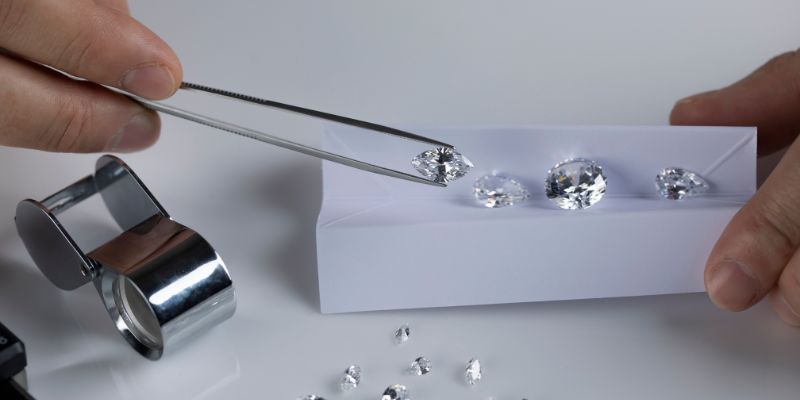
Lastly, every ring is passed through quality control and checked under 10x magnification to ensure they meet our high standards before being delivered to our customers.
All of our jewellery is made-to-order and can be customised how you wish. Discover our range of diamond rings online or learn more about our bespoke diamond jewellery service if you have a unique ring design in mind.







 Unlock private sale access
 Birthday privileges
 Plus a world of exclusives, curated for you.


Jewellery making is an art form that requires precision and skill. Several steps need to be taken when crafting diamond rings, such as designing and casting to polishing and quality checks. In this article, we discuss how diamond rings are made and the process we follow.
How are diamond rings made? In steps
Step 1 - Creating the design
Step 2 - Making a wax model and casting the rings
Step 3 - Sizing the rings
Step 4 - Pre-polishing the rings
Step 5 - Setting the stones
Step 6 - Polishing the rings and rhodium plating
Step 7 - Final checks in quality control
1. Designing diamond rings
Every diamond ring, such as an engagement ring or wedding ring, begins its life as an idea or vision. From this, the designer creates a sketch by hand or computer-aided design (CAD) to bring their idea to life. Once the design is finalised, it begins the manufacturing process.
2. Wax model making and casting
The next step is to create a wax model of the ring. Following the design, the craftsperson uses various types of wax and wax carving tools to carve a model of the ring. Once complete, it should look like a replica of the ring design.
A plaster mould is then made of the wax model so that it can be duplicated as many times as necessary. When a specific ring style is required, hot wax is injected into the plaster mould and removed once it is cooled. This serves as a casting model.
Wax models of different ring styles are combined in what is called a ‘wax tree’. This is to keep every ring that needs to be cast in a specific metal together. Wax trees are put into forms and plaster is poured in to create a mould. They are then baked at a high temperature, to evaporate the wax models inside and leave behind a cavity of ring styles ready to be filled with metal.
Metal is transformed into liquid by heating it to extreme temperatures. The desired metal is then vacuumed into the plaster form with the cavity of ring styles. The metal hardens to form raw castings of the rings.
3. Preparing and sizing the rings
The raw castings are removed individually and prepared for sizing. Each ring is gently tapped with a hammer and heated, to enable it to be sized correctly. It is then filed into shape and finished with a fine, abrasive rubber wheel. The rest of the ring is then prepared for the pre-polishing process.
4. Pre-polishing
During pre-polishing, a variety of mops and different grades of polishing compound are used to make the metal look its best and prepare the ring for setting.
5. Setting diamonds or gemstones
If multiple diamonds are being used, for example, in an eternity ring or engagement ring, the diamonds are measured and matched ahead of being set. The diamonds or gemstones are then set into the ring using specialist tools.
6. Polishing and rhodium plating the ring
The ring is then sent to be polished, this time using finer polishing compounds. If the customer has requested it, this is when any white gold rings are rhodium plated to protect the metal from scratching and enable it to keep it’s bright white colour.
7. Quality control
Lastly, every ring is passed through quality control and checked under 10x magnification to ensure they meet our high standards before being delivered to our customers.
All of our jewellery is made-to-order and can be customised how you wish. Discover our range of diamond rings online or learn more about our bespoke diamond jewellery service if you have a unique ring design in mind.